HD technology,a human touch.
Service, development and clichés in high definition.
HD-flexo
HD-flexo screen ruling
Frequency
Since 1985
Technical service
Service tailored to every project.
Technical reception
Qualified team — interpersonal and technical — that reviews every project precisely and supports both end clients and third-party agencies.
Tailored analysis
Service fully oriented to the client's real need. No rigid protocols that don't fit what the client expects.
History & traceability
The technical receptionist tracks every process from arrival to departure — any project, any stage, always traceable.
Pillars
From file to plate.
Technical analysis
File intake, spec validation, alignment with PPC and client. Every project has a dedicated technical owner.
Final art & color
Vectorization, trapping and sleeve distortion. GMG ColorProof certified.
Woodpecker Nano HD
Woodpecker Nano HD microscreens — 2000 lpi on photopolymer. Solids without mottling, stable fine screens, high ink density.
Production flow
Six stages, ΔE tracked.
Every stage instrumented. You know where your order is in real time, from briefing to shipping.
Briefing
Specs, deadlines, SKUs validated with PPC
Final art
Vectorization, trapping and file finalization
Development
Cylinder distortion and imposition
CtP imaging
Photopolymer plate, up to 5,080 dpi, Woodpecker Nano
Color + proofs
GMG ColorProof · ΔE < 1
Run
Registration mark · NFSe · shipping
Proofs · colour reference
Sign-off before the press rolls.
Colour fidelity
Where the professional identifies colour fidelity and the nuances of a complex, detail-rich job. GMG ColorProof, gauged at every stage.
On the real material
Lets converters and agencies visualise the packaging on the same material it will be printed on — size, shapes, structure, elements.
Personal service
Compendium · p. 6The person who takes the job is the one who understands it.
Technical reception
The company has a staff qualified both in personal dealing and in technical terms, able to carry out a precise examination of each project, offering support to the end customer and to outsourced agencies as well.
Technical analysis and suggestions
Service is oriented entirely to the customer's real demand, avoiding as far as possible rigid protocols that do not apply to what they need and expect.
History and traceability
The technical receptionist has tools to follow each customer process from arrival to dispatch, and it can be traced at any stage of its execution.
Development
Compendium · p. 8From editing to closing the file.
Development
From editing to closing the file, the company uses software developed specifically for the packaging sector, made and supplied by Esko. Adobe applications are also used for complementary functions.
Quality control
Among the procedures used to check the work, the company uses DotSpy, through which possible alterations or variations against the original can be verified.
Approval
All work can be approved by e-mail and through specific software for sending and receiving PDF files.
Printing plates
Compendium · p. 10What a plate is, and what it does.
The printing form
The photopolymer plate is a printing form — also known as a matrix — which may carry text, images and geometric elements and, combined with ink, anilox and other supplies, reproduces that content on many kinds of substrate (plastic, paper, aluminium, tube, squeeze tube and others).
Three processes
The same job is imaged for each process: flexography, dry-offset and letterpress. The plate base changes with the process — metal for dry-offset, polyester for letterpress.
Colour separation
Each plate carries one colour. Artwork with text, image and geometric elements is separated into cyan, magenta, yellow and black — one plate for each.
Flexography
Compendium · p. 12Woodpecker microscreens and high-definition imaging.
High definition
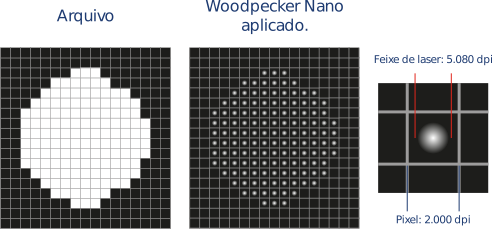
The company works with equipment that images plates in high definition, reaching up to 5,080 dpi.
High-standard printing
Combining the microscreens with the imaging produces results in print that stand on their own.
The measured difference
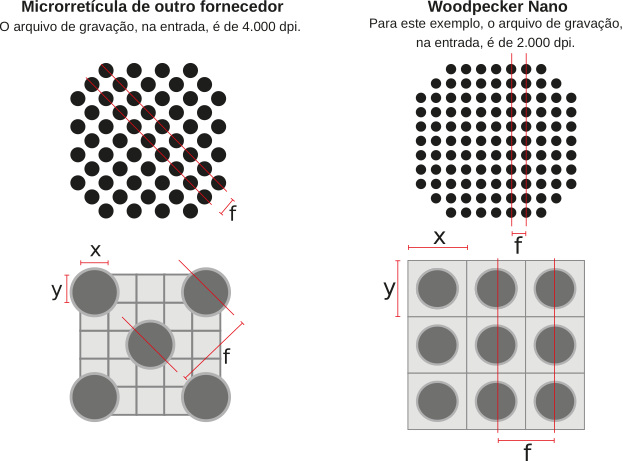
With another supplier's microscreen the file goes in at 4,000 dpi, x and y measure 6.35 µm and distance f is 17.96 µm — a screen frequency of 1,414 lpi. With Woodpecker Nano the file goes in at 2,000 dpi, x and y measure 12.7 µm and distance f is 12.7 µm — 2,000 lpi. Source: XSYS Global.
What it contributes to flexography
Compendium · p. 14Measured at the DFTA, with solvent-based inks on white PE.
Better print quality
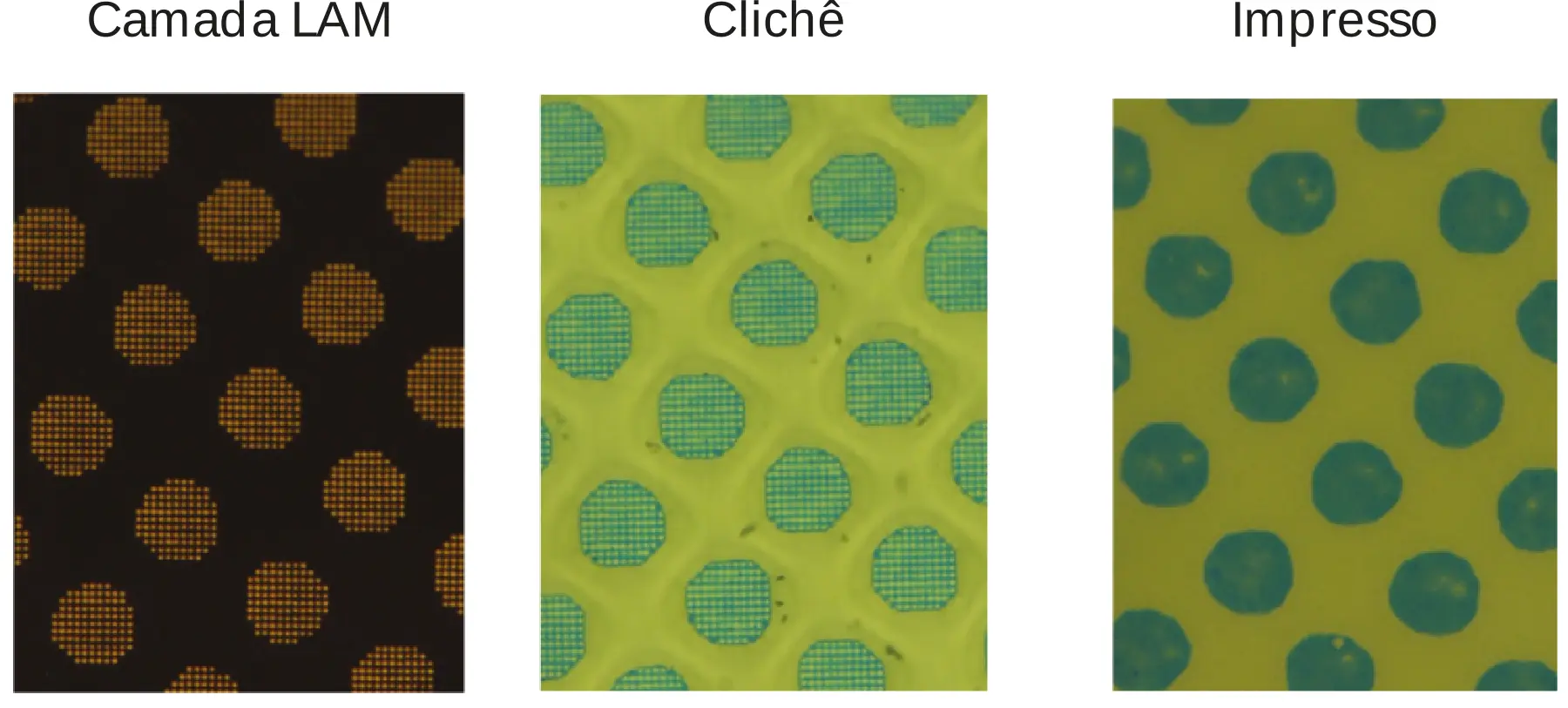
Solid ink transfer with higher density and more evenness. Ability to hit the target solid ink density with a lower-volume anilox and a higher screen ruling. Elimination of banding between dots and of tonal jumps. Reduction or elimination of halo and edge-void effects.
Lower costs
Lower ink cost, through better pick-up and transfer from a low-volume anilox. Lower printing cost, through greater ability to run hybrid plates. The wider tonal range makes a fixed colour palette more viable, saving set-up time.
Faster replacement
Plate imaging at higher productivity. No extra steps at the RIP stage, and no decisions to make in prepress. Smaller imaging files, faster to process and transfer.
Dry-offset
Compendium · p. 15Photopolymer plates on a metal base.
Cliart offers
The company works with the best raw materials available and, above all, has a team with full command of the technique required for prepress and support to customers running indirect printing on rigid substrates.
Application
This kind of plate is used for printing on tubes, cups, cans, pots, squeeze tubes, aerosols and caps.
- Higher performance when combining gradients with solids.
- Stable transfer in the minimum-dot areas.
- Long runs with consistency, without loss of quality.
Letterpress
Compendium · p. 16Photopolymer plates on a polyester base.
Cliart offers
The company works with the best raw materials available and, above all, has a team with full command of the technique required for prepress and support to customers running direct printing on semi-flexible and flexible substrates.
Application
This kind of plate is used for printing on squeeze tubes, labels and tags.
- Higher performance when combining gradients with solids.
- Stable transfer in the minimum-dot areas.
- Long runs with consistency, without loss of quality.
Proofs
Compendium · p. 18See the colour and the material before the press runs.
Colour proof (GMG)
It is with this kind of proof that a professional will judge colour fidelity and the nuances of a complex, detailed job.
Substrate proof
When, beyond knowing the printed result, the size, shapes, structure and elements of the job must be confirmed, this proof lets both converters and agencies see the package on the very material it will be printed on.
- Lower risk of rework.
- Keeps the press from standing idle for an open-ended time.
- An approximate view of the final printed result.
Logistics
Compendium · p. 20Planned delivery.
Planned delivery
The company works with several carriers, always looking for the best and fastest way to send the plates, according to each location and the agreed deadlines.
Markets
What gets packed decides how it gets imaged.
A plate for a frozen-food bag and a plate for a bottle label are not solving the same problem. These are the markets that come through the house, and what each one demands of whoever images the plate.
- Frozen and chilled
Bags and film for frozen cuts, chicken, bacon, sausage, mortadella, meat and offal.
Printing on low-density polyethylene, which stretches on press and returns the artwork slightly larger than it went in. Distortion is calculated before imaging, for that press's cylinder. And the mandatory text must stay legible under condensation and cold handling, which changes decisions about type size and solids.
- Bags and carrier bags
Supermarket carrier bags, bread bags, bin liners, plastic envelopes, with or without handles.
Wide web and large areas of flat colour — where a badly imaged plate gives itself away: the solid comes out mottled or shows anilox banding. It calls for control of minimum dot and relief, and for colour-to-colour registration that holds at bag-line speed.
- Ice and ice cream
Ice-cream tubs, cups and bags, lollies, açaí, frozen fruit pulp, and ice in cubes, blocks or bags.
A cold surface and a small pack at once: flavour, brand and mandatory information must fit and stay legible on a label held with a wet hand. On ice bags the material is thin and the ink sits shallow — the screen design matters more than resolution on paper.
- Dairy
Packaging for cheese, milk, cream cheese, cream and yoghurt — film, label and pot lidding.
Barrier film and laminate, where the brand colour is what the shopper recognises on shelf before reading anything. Brand colour is checked against an ICC profile and proofed before the run, because the same Pantone printed on two substrates does not give the same shade.
- Labels and stickers
Bottle and mineral-water labels, self-adhesive stickers, promotional decals, sleeves.
This is where a fine screen earns its keep: product photography on a small label, tight colour-to-colour registration, and tonal transitions that must not show banding. A sleeve adds the material's own deformation as it shrinks onto the bottle, and that sum is done in the artwork, not on press.
- Snacks, biscuits and confectionery
Packs for crisps, shoestring potatoes, popcorn, peanuts, cassava-starch biscuits, corn flakes, chocolate and sweets.
Metallised, laminated and clear film — three grounds that give the same ink back three different ways. On metallised stock, the opaque white decides whether the colour above it is the one approved. And the small type of nutrition tables must survive imaging without its counters closing up.
- Beauty and personal care
Bottles and sachets for shampoo, conditioner, hair masks, creams and sunscreen — often as a sleeve over the bottle.
A small print area and a lot of mandatory information: ingredients, directions, regulatory registration. It calls for fine type whose counters do not close at imaging, and for sleeve artwork already compensated for the bottle's deformation. Metallised stock and spot varnish are common, and each changes the colour seen above it.
- Dry goods and grocery
Bags and bales for crystal sugar, rice, beans, pasta, wheat and cassava flour, tapioca mix, corn and seasonings.
Heavy weight in a thin material, and the bag ships stacked: the artwork is read through the deformation of the product inside, not on a flat surface. Large solids with the brand printed over them, and registration that holds on a baling line — where speed is higher and tolerance lower.
- Household cleaning and hygiene
Packs for bleach, detergent, soap, toilet paper and bin liners — in bottles, drums and film.
The contents attack the pack from inside and transport scuffs it from outside. Ink and substrate are checked together, because a combination that passes on paper can fade in contact with chlorine. This is a market where a substrate proof is worth more than a paper proof.
Glossary
The words of the trade, plainly put.
The terms that turn up in the requests reaching the house, and the ones heard on the shop floor. If one is missing, ask — the answer joins the list.
- Platemaking housealso Prepress
- The house that images printing plates. It is the trade word, the one used on the phone and on the shop floor; “prepress” is the same thing said more broadly, since it also covers the file work before imaging.
- Alteration
- Changing a job that already exists: a new weight, a corrected legal text, a different flavour in the range. It is the most common request that reaches the house, and shorter than a new job because the artwork and the profile are already on file.
- Printing platealso Photopolymer, matrix
- The printing form: a photopolymer plate carrying text, images and geometric elements in relief which, combined with ink and anilox, reproduces that content on the substrate. Each colour in the job has its own plate.
- Imaging
- The moment the laser writes the job onto the plate. Imaging resolution decides the smallest dot that can be held — here, up to 5,080 dpi.
- Re-imaging
- Imaging an existing plate again, because it wore out on press, was damaged, or the next run needs it back. The file is the same; the plate is new.
- Mounting
- Laying the pieces out to the cylinder format, with the right distances between them, so the print comes out in the correct repeat. This is where it is decided how many pieces fit in one turn.
- Repeat
- Producing a job again exactly as it went out last time, without touching the artwork. The approved file stays on record, and that is the starting point.
- Flexographyalso Flexo
- Direct printing from a flexible relief plate, reel-fed. It is the dominant process in flexible packaging: bags, carrier bags, labels, films.
- Dry offset
- Indirect printing on rigid substrates, with a metal-backed plate. Used on tubes, cups, cans, pots, aerosols and caps.
- Letterpress
- Direct printing on semi-flexible and flexible substrates, with a polyester-backed plate. Used on tubes, labels and tags.
- Final artwork
- The closed file, ready to image: colours separated, text converted, bleed and marks in place. It is what the house checks before any plate is imaged.
- Colour separation
- Breaking the artwork down into the colours the press will run — cyan, magenta, yellow and black, plus any spot colours. Each separated colour becomes a plate.
- Anilox
- The engraved roller whose cells meter the ink delivered to the plate. Its volume, together with the plate screen, decides the density achievable in print.
- Screen rulingalso Screen
- The density of the dot grid that builds the tones. The higher it is, the finer the gradient and the smoother the highlight transition — and the more demanding the imaging.
- Microscreenalso HD flexo
- A pattern imaged inside the dot itself, changing how it picks up and releases ink. It is what allows denser solids from a lower-volume anilox, and minimum dots that survive the press.
- Colour proof
- A calibrated print showing colours and nuances before the press runs. It lets a complex job be judged without spending a run.
- Substrate proof
- A proof made on the very material the pack will be printed on. It shows size, shapes and structure, not only colour — the pack seen before it exists.
- Substrate
- The material that takes the ink: plastic film, paper, aluminium, board, tube. Each responds differently to the same plate and the same ink.
- Trapping
- The minimum overlap between two neighbouring colours, so a registration shift on press does not open a white line between them. Decided in the final artwork, not at imaging.
- Reel
- The roll of material feeding the press. The mounting repeat must close exactly with one turn of the cylinder so the print repeats without drift along the reel.
Ready?
Send your file.
Check the technical specs or talk directly to our team. A human reply, within 4 business hours.